WooCommerce Payment Gateway Per Product: Complete Setup
Master the WooCommerce payment gateway per product setup. Assign Stripe, PayPal, or COD to specific items, categories, and roles with this deep-dive guide.
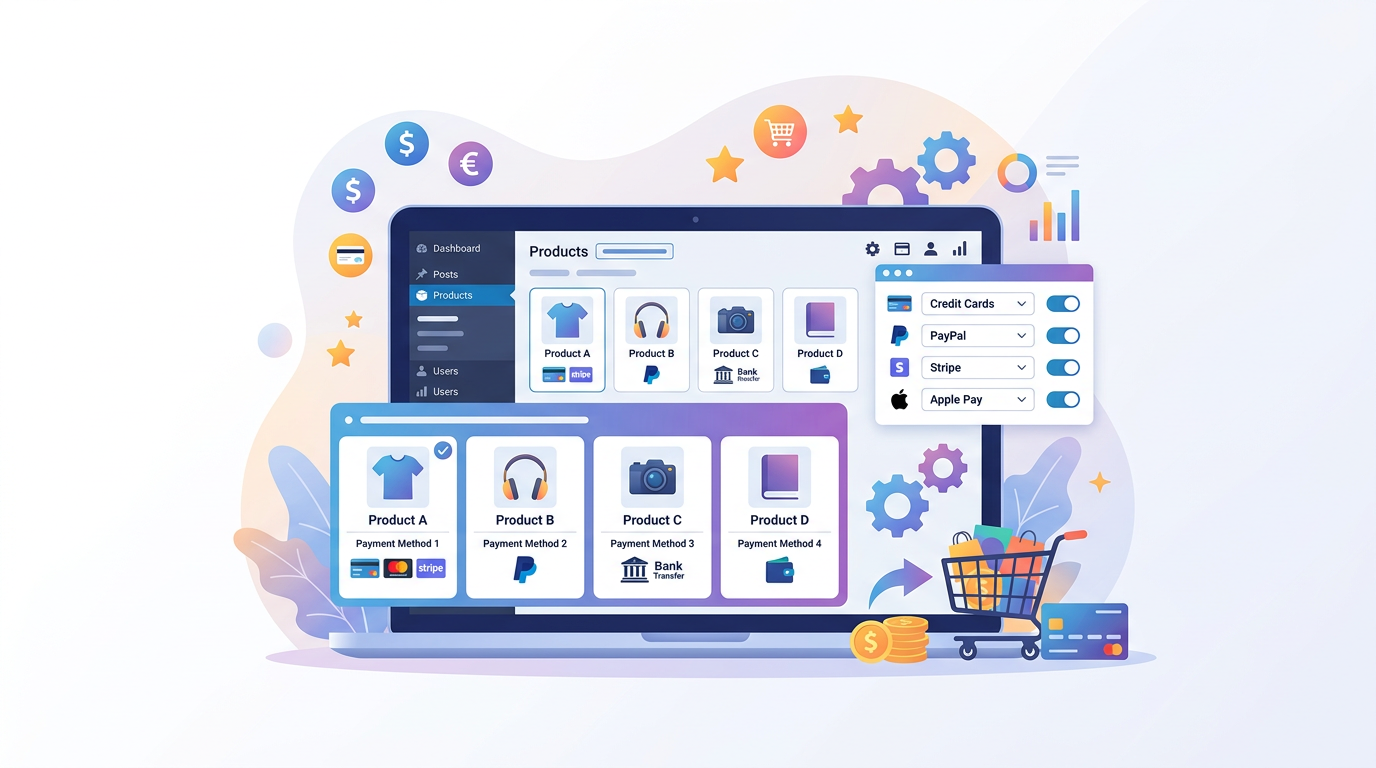
A customer adds a $12 e-book to their cart, proceeds to checkout, and immediately abandons when they see a Cash on Delivery option they cannot use in their country. On the same store, a B2B buyer tries to pay a $4,500 wholesale invoice with a credit card, but the WooCommerce Stripe payment gateway is hidden behind a role restriction that was never configured correctly. These are not edge cases — they are daily checkout leaks caused by a single gateway serving every product, every customer, and every cart total. Assigning a WooCommerce payment gateway per product, category, or user role eliminates that mismatch. You control exactly which methods appear, when they appear, and to whom.
Why Default WooCommerce Gateways Leak Revenue
WooCommerce enables every activated gateway globally. Once you turn on Stripe, PayPal, and COD, they appear for every SKU regardless of product type, price, or buyer role. That blanket approach creates friction in three predictable ways.
Mismatched Methods for Product Types
Digital downloads, subscription renewals, and high-ticket B2B invoices each demand different payment rails. Showing COD on a $7 PDF ebook wastes screen space and confuses international buyers. Forcing credit cards on a local service booking where customers expect to pay on arrival kills trust. Mapping gateways to product attributes ensures the checkout matches the purchase context.
Cart-Total Thresholds That Break Conversions
Many stores want COD available only for orders under $200 and credit card payment required above that threshold. WooCommerce has no native cart-total conditional for gateways. Without a per-product or cart-total rule, you either leave high-risk COD open to fraud or block it entirely and lose customers who rely on it.
Role-Based Visibility Gaps
Wholesale buyers, VIP members, and retail customers often need different payment terms. A store might offer net-30 invoicing to approved wholesale roles while showing standard credit card checkout to everyone else. Without role-based gateway control, you force all users through the same payment flow, regardless of their account status.
How to Assign Gateways Per Product, Category, and Role
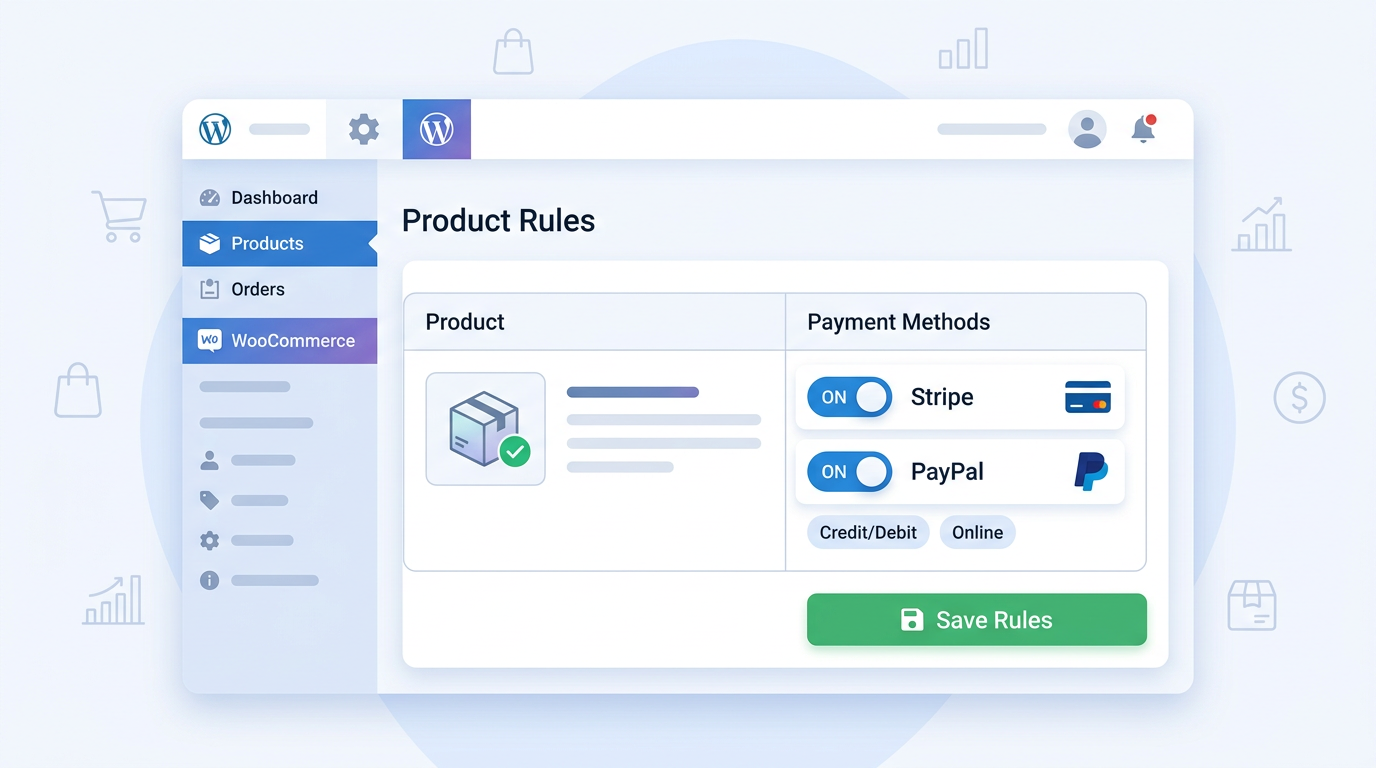
The Dreamfox Payment Gateway per Product for WooCommerce plugin handles this mapping without touching code. The interface lives under WooCommerce → Payment Gateway Per Product, where you build rules that pair gateways with products, categories, tags, user roles, and cart totals. Below is the exact workflow.
Step 1: Navigate to the Rule Builder
From your WordPress admin sidebar, go to WooCommerce → Payment Gateway Per Product. Click Add New Rule. You will see a form with four core condition groups: Product Conditions, User Role Conditions, Cart Conditions, and Gateway Selection.
Step 2: Define Product Conditions
Under Product Conditions, choose the matching scope:
- Specific Products: Select individual SKUs or search by product name. Use this for one-off items like a premium installation service that requires a deposit via bank transfer.
- Product Categories: Pick entire taxonomies such as "Digital Downloads" or "Wholesale Only." This is the fastest way to hide COD from intangible goods.
- Product Tags: Filter by tags like "subscription" or "fragile." Tags work well when categories are already used for something else.
You can set the rule to Show or Hide the selected gateways when the condition matches.
Step 3: Add User Role Conditions
Under User Role Conditions, select which roles trigger the rule. Common setups include:
- Wholesale: Show Bank Transfer and Invoice; hide COD and PayPal.
- Retail: Show Stripe, PayPal, and COD; hide Invoice.
- Logged Out: Show only Stripe for guest checkout, hiding role-specific methods.
If no role matches, the rule does not fire, and the default gateway list remains intact.
Step 4: Set Cart-Total or Quantity Thresholds
Cart Conditions let you add minimum and maximum order values. For example, set a minimum cart total of $500 to show the Bank Transfer gateway and a maximum of $200 to show COD. You can also filter by cart quantity, which is useful when you want a special payment method to appear only for bulk orders of 10+ items.
Step 5: Select Gateways and Save
Check the boxes for the gateways this rule controls. Save the rule. Repeat for each scenario. Rules stack: if a product matches multiple rules, the plugin merges the allowed gateways. If you need a fallback when no rule matches, enable the Fallback Payment Method in the plugin settings so checkout never breaks.
Concrete Example: Digital Downloads vs. Physical Goods
Here is a real-world configuration that stops COD from appearing on digital products while keeping it available for local physical orders.
Rule A: Hide COD on Digital Downloads
- Condition: Product Category = "Digital Downloads"
- Action: Hide = Cash on Delivery
- User Role: All roles
- Cart Total: No restriction
Result: Any cart containing only digital downloads removes COD from the checkout page. The customer sees Stripe and PayPal instead.
Rule B: Show COD Only for Local Physical Orders Under $150
- Condition: Product Category = "Physical Goods"
- Action: Show = Cash on Delivery
- User Role: All roles
- Cart Total: Minimum $0, Maximum $150
- Shipping Zone: Local Pickup (configured in WooCommerce → Settings → Shipping)
Result: COD appears only when the cart total is $150 or less and the customer selects local pickup. International physical orders over $150 never see COD, reducing fraud risk.
Rule C: Wholesale Role Gets Bank Transfer Only
- Condition: Product Category = "Wholesale"
- Action: Show = BACS (Bank Transfer), Hide = Stripe, Hide = PayPal, Hide = COD
- User Role: Wholesale Customer
- Cart Total: No restriction
Result: A logged-in wholesale buyer sees only Bank Transfer at checkout. A retail buyer viewing the same product sees Stripe and PayPal. The product page remains unchanged; only the payment method list adapts.
Handling Edge Cases That Break Checkout
Rule-based gateway control introduces edge cases. If you do not plan for them, customers hit dead ends at checkout.
Overlapping Rules and Priority
If Rule A hides COD for a category and Rule B shows COD for a specific product inside that category, the plugin needs a clear priority. Set specific product rules above category rules in the rule list. The plugin evaluates rules top-down, so the first matching rule takes precedence. Test with a product that belongs to multiple categories to confirm the intended gateway appears.
Empty Cart Results
If every gateway is hidden by a rule and no fallback is set, the checkout page renders without any payment option. Customers cannot complete the order. Always enable a Fallback Payment Method in the plugin settings. Choose Stripe or PayPal as the fallback so the store stays operational when rules do not match.
Variation-Level Control
Variable products inherit gateway rules from the parent product by default. If you need a specific variation — such as a "Gift Wrap" add-on — to trigger a different gateway, you must assign the rule at the variation level. Go to the product edit screen, open the Variations tab, and set the payment gateway restriction for each variation individually. This prevents the parent rule from overriding the variation-specific requirement.
Gateway Conflicts with Subscriptions
WooCommerce Subscriptions requires a gateway that supports recurring payments. If you hide Stripe and show COD for a subscription product, the renewal will fail. Always ensure at least one recurring-capable gateway remains visible for subscription products. Use the product category "Subscriptions" to enforce this rule globally.
Comparison: Plugin vs. Custom Code vs. Native WooCommerce
| Approach | Setup Time | Maintenance | Flexibility | Risk of Checkout Breakage |
|---|---|---|---|---|
| Dreamfox Plugin | 10-15 minutes | Zero (UI-driven) | Product, category, tag, role, cart total, fallback | Low (fallback prevents dead ends) |
| Custom PHP Snippet | 1-3 hours | High (code updates with Woo changes) | Unlimited but requires developer | High (logic errors hide all gateways) |
| Native WooCommerce | N/A (not supported) | N/A | None (global only) | N/A |
Custom code works if you have a developer on retainer. A single `woocommerce_available_payment_gateways` filter can hide gateways based on cart total or product category, but it breaks when WooCommerce updates its gateway class structure or when you add new products. The plugin stores rules in the database and renders them through the admin UI, so non-technical staff can adjust visibility without touching `functions.php`. For stores with more than 50 products or multiple user roles, the plugin pays for itself in saved developer hours within the first month.
Best Practices for WooCommerce Payment Gateways
Even with per-product control, your gateway strategy needs guardrails.
Audit Your Active Gateways Quarterly
Every enabled gateway adds a line item to checkout. If a gateway processes zero orders over 90 days, disable it. Fewer options mean faster checkout decisions. Use WooCommerce → Reports → Payments to identify unused methods.
Test Every Rule with a Staging Cart
Before publishing a new rule, add the target product to your cart, switch to a test user role, and verify the checkout page. Check guest checkout, logged-in retail, and wholesale roles separately. Rules that work for one role often leak into another if the role condition is misconfigured.
Keep the Best Payment Gateway for WooCommerce Visible
Stripe and PayPal remain the best payment gateway for WooCommerce for most stores because they support global cards, Apple Pay, Google Pay, and recurring billing. Use per-product rules to hide them only when a specific scenario demands it — such as bank transfer for B2B invoices or COD for local pickup. Do not hide your primary gateway globally; restrict it contextually instead.
Document Your Rule Matrix
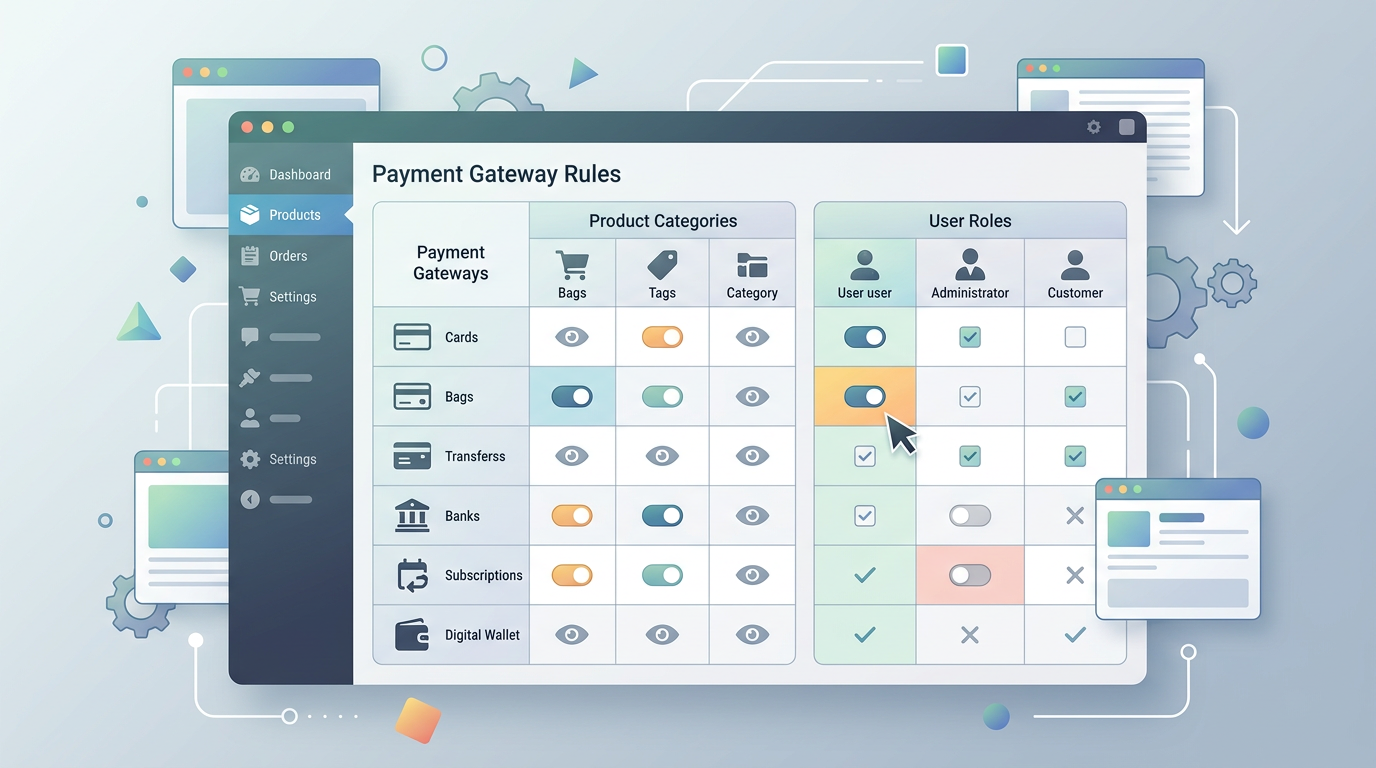
Create a simple spreadsheet that maps each product category to its allowed gateways and the user roles that trigger them. Share this with your team so anyone can troubleshoot a missing payment method without guessing. Update the sheet whenever you add a new gateway or product line.
Scaling Gateway Rules as Your Store Grows
As your catalog expands, rule management becomes the bottleneck. Here is how to keep it clean.
Use Categories Before Individual Products
Assigning gateways to 200 individual products creates 200 rules. Assigning them to 5 categories creates 5 rules. Start with categories and tags. Drill down to individual products only when a single SKU has a unique payment requirement that does not apply to its category.
Combine Shipping and Payment Rules
Payment gateways often depend on shipping methods. COD makes sense only for local delivery; bank transfer makes sense for international B2B. Use the Dreamfox Shipping Methods per Product for WooCommerce plugin to restrict shipping options per product, then mirror those restrictions in your payment gateway rules. When shipping and payment rules align, customers never see impossible combinations like "International Shipping + COD."
Monitor Fallback Triggers
The fallback gateway activates when no rule matches. If your fallback processes 40% of orders, your rules are too restrictive. Review the fallback usage in your gateway reports and relax rules that are blocking valid payment methods. A well-tuned rule set should trigger the fallback on less than 5% of orders.
Conclusion
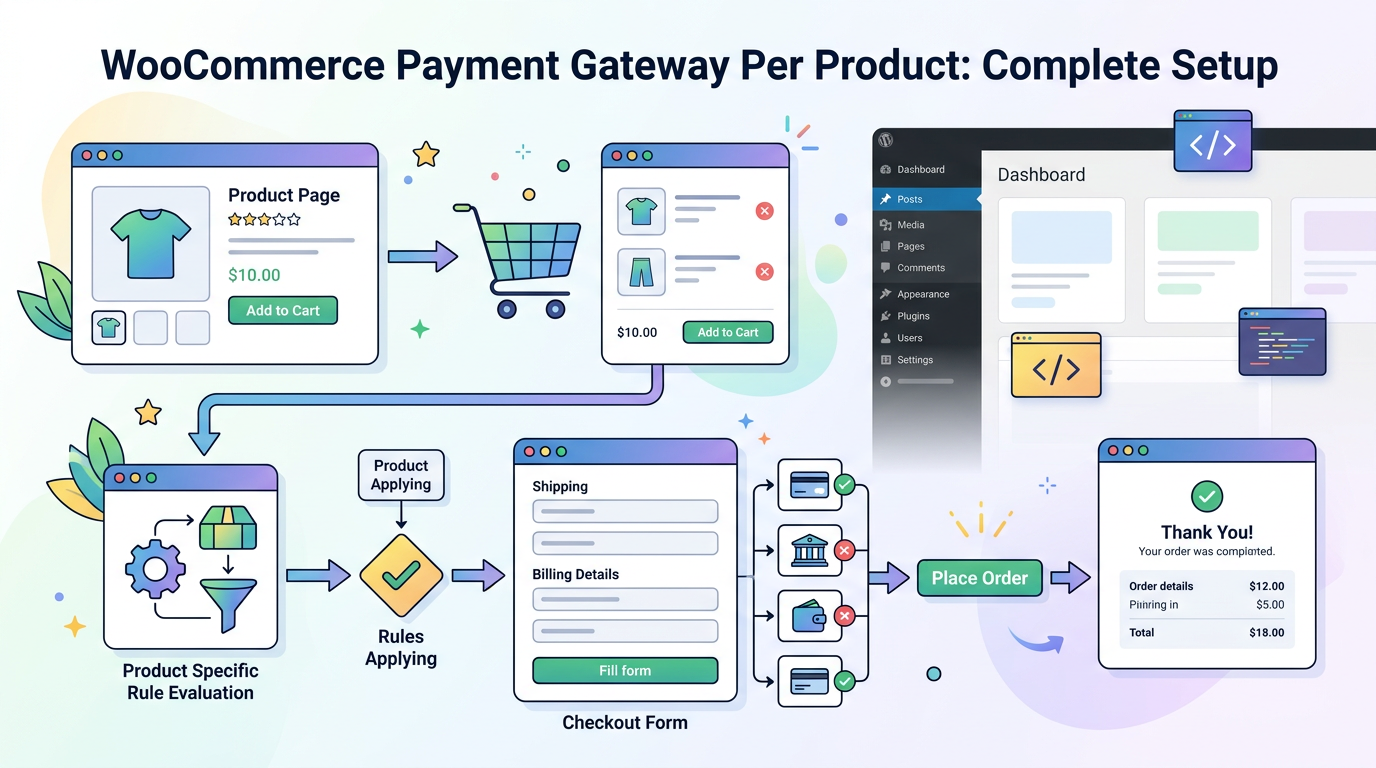
Assigning a WooCommerce payment gateway per product, category, or user role stops checkout friction before it happens. You show the right method to the right buyer at the right cart total, and you eliminate the dead ends that cause abandoned carts. The Dreamfox Payment Gateway per Product for WooCommerce plugin makes this rule-based control visual, testable, and safe with fallback protection — no PHP required. Install it, build your first rule, and watch your checkout conversion stabilize within a week.
FAQ
- Which payment gateway is best for WooCommerce?
- Stripe and PayPal are the best payment gateway for WooCommerce for most stores because they support global credit cards, digital wallets like Apple Pay and Google Pay, and recurring payments for subscriptions. Choose the one that offers the lowest fees in your country and integrates with your existing merchant account.
- What are the disadvantages of WooCommerce?
- WooCommerce requires self-hosting, which means you manage security, performance, and plugin updates yourself. Heavy stores with many extensions can slow down without proper hosting, and advanced features like per-product payment rules require additional plugins or custom code.
- What are the top 5 payment gateways?
- The top 5 payment gateways for WooCommerce are Stripe, PayPal, Square, Authorize.Net, and Razorpay. Stripe and PayPal lead for global coverage, Square works well for US-based brick-and-click stores, Authorize.Net suits enterprise merchants, and Razorpay dominates the Indian market.
- Is woopayment good?
- WooPayments is a solid native gateway built by the WooCommerce team, offering easy setup, competitive rates, and deep integration with the dashboard. It works best for US, UK, and EU stores but has limited country support compared to Stripe or PayPal, so check availability in your region before committing.
- Can I build my own payment gateway?
- Yes, you can build a custom WooCommerce payment gateway by extending the WC_Payment_Gateway class and implementing the process_payment method. You must handle PCI compliance, webhook security, and error recovery yourself, which is why most stores use established gateways unless they have a specific regional or banking requirement.
This article is part of our WooCommerce payments topic hub, where the related plugins and guides live together.